

100-genuine

Aruba 340 Series in Dubai UAE

SKU: Aruba 340 Series

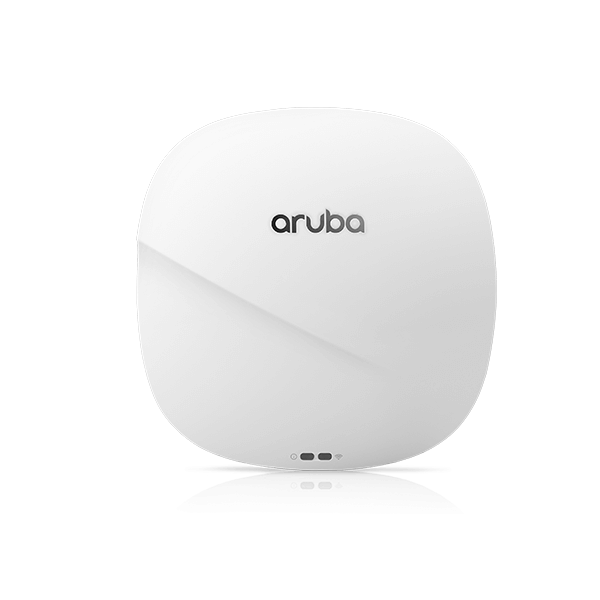
ARUBA 340 SERIES CAMPUS ACCESS POINTS Very high performance 802.11ac Wave 2 (WiFi 5) APs with dual-5 GHz and multi-gig Ethernet support

In a digital workplace, the Aruba 340 series access points deliver the fastest 802.11ac gigabit internet speeds and a great user experience for mobile devices and applications. These APs include an integrated HPE SmartRate multi-gig Ethernet connector that is 802.3bz compliant to avoid wired bottlenecks and provide unrivalled wireless performance and capacity. The 340 series’ unique and flexible dual-5 GHz architecture allows users to double 5 GHz capacity where needed without sacrificing performance.

KEY FEATURES

• Designed with an integrated, 802.3bz compliant, HPE SmartRate multi-gig Ethernet port to eliminate wired bottlenecks
• Maximum data rates of 2,166 Mbps in the 5 GHz band and 800 Mbps in the 2.4 GHz band (for an aggregate peak data rate of 3.0 Gbps in dual-band and 4.3 Gbps in dual-5GHz)
• Includes integrated Bluetooth Low Energy (BLE) radio, for advanced location and indoor wayfinding
• Participates in Aruba’s Dynamic Segmentation solution

Support from Our Knowledge Hub

Ask us anything!

Tel: +971 4352 24 33

Description

Overview:

The 340 series can automatically detect and classify 802.11ac Wave 2 enabled mobile devices thanks to Aruba’s sophisticated ClientMatch technology. ClientMatch can now automatically join Wave 2 capable devices onto a single Wave 2 radio, allowing multi-user MIMO performance to be reached without the drawbacks of slower 802.11ac and classic 802.11n capable mobile devices. This translates to more network capacity and improved network efficiency.
The 340 series APs provide best-in-class next-generation 802.11ac Wi-Fi infrastructure with maximum data rates of 2,166 Mbps in the 5 GHz band1 and 800 Mbps in the 2.4 GHz band (for an aggregate peak data rate of 3.0 Gbps in dual-band mode and 4.3 Gbps in dual-5 GHz mode).

UNIQUE BENEFITS

• Unified AP – deploy with or without controller
– The 340 Series APs can be deployed in either controllerbased (ArubaOS) or controllerless (InstantOS) deployment mode
• Dual Radio 4×4 802.11ac access point with Multi-User MIMO (wave 2)
– Supports up to 2,166 Mbps per radio in the 5 GHz band (with 4SS/VHT80 or 2SS/VHT160 clients) and up to 800 Mbps in the 2.4 GHz band (with 4SS/VHT40 clients)
– Antenna polarization diversity (fixed) for optimized RF performance
• Optional dual-5 GHz mode supported, where the 2.4 GHz radio is converted to a second 5 GHz radio
– Both 5 GHz radios providing full coverage, doubling the performance and capacity
– Unlike competitive solutions, the 340 Series is designed to isolate the two 5 GHz transmitters for higher performance
– Conversion can be manual/fixed, or automatic and dynamic (software controlled, under-the hood), based on system-wide capacity and load in both bands
• HPE SmartRate uplink Ethernet port (E0)
– Supports up to 2.5 Gbps with NBase-T and IEEE 802.3bz Ethernet compatibility
– Backwards compatible with 100/1000Base-T
• Hitless PoE failover between both Ethernet ports
• Built-in Bluetooth Low-Energy (BLE) radio
– Enables location-based services with BLE-enabled mobile devices receiving signals from multiple Aruba Beacons at the same time
– Enables asset tracking when used with Aruba Asset Tags
• Advanced Cellular Coexistence (ACC)
– Minimizes interference from 3G/4G cellular networks, distributed antenna systems and commercial small cell/femtocell equipment
• Quality of service for unified communications applications
– Supports priority handling and policy enforcement for unified communication apps, including Skype for Business with encrypted videoconferencing, voice, chat and desktop sharing
• Aruba AppRF technology leverages deep packet inspection to classify and block, prioritize, or limit bandwidth for thousands of applications in a range of categories

SPECIFICATIONS

Hardware Variants

• AP-344: External antenna models
• AP-345: Internal antenna models

Wi-Fi Radio Specifications

• AP type: Indoor, dual radio, 5 GHz 802.11ac 4×4 MIMO and 2.4 GHz 802.11n 4×4 MIMO
– The 2.4 GHz radio supports all 802.11ac rates as well (proprietary extension)
• Software-configurable dual radio supports:
– Dual-radio mode: 5 GHz (Radio 0) and 2.4 GHz (Radio 1)
– Dual-5 GHz mode: upper 5 GHz (Radio 0) and lower 5 GHz (Radio 1)
• 5 GHz:
– Four spatial stream Single User (SU) MIMO for up to 1,733 Mbps wireless data rate to individual 4SS VHT80 or 2SS VHT160 client devices
– Four spatial stream Multi User (MU) MIMO for up to 1,733 Mbps wireless data rate to up to four 1SS or two 2SS MU-MIMO capable client devices simultaneously
– Peak datarate increases to 2,166 Mbps when using 1024-QAM modulation (proprietary extension)

• Supported data rates (Mbps):

– 802.11b: 1, 2, 5.5, 11
– 802.11a/g: 6, 9, 12, 18, 24, 36, 48, 54
– 802.11n: 6.5 to 600 (MCS0 to MCS31)
– 802.11ac: 6.5 to 1,733 (MCS0 to MCS9, NSS = 1 to 4 for
VHT20/40/80, NSS = 1 to 2 for VHT160)
– 802.11ac: 1,950 and 2,166 (MCS10 and MCS11, NSS = 1 to 4 for VHT20/40/80, NSS = 1 to 2 for VHT160)6
– 802.11n high-throughput (HT) support: HT20/40
– 802.11ac very high throughput (VHT) support:
VHT20/40/80/160
– 802.11n/ac packet aggregation: A-MPDU, A-MSDU

Wi-Fi Antennas

• AP-344: External antenna models. Two sets of four RP-SMA antenna connectors:
– Primary: A0 – A3, connected to chains 0 through 3 respectively on each associated radio
» With AP in dual-radio mode: dual-band interfaces, diplexing signals to/from radio 0 (full 5 GHz) and radio 1 (2.4 GHz)
» With AP in dual-5 GHz mode: 5 GHz interfaces from radio 0 (upper 5 GHz)
– Secondary: B0 – B3, connected to chains 0 through 3 respectively
» With AP in dual-radio mode: not used
» With AP in dual-5 GHz mode: 5 GHz interfaces from radio 1 (lower 5 GHz)
– Total internal losses between radio and external connectors:
» With AP in dual-radio mode: 2.0 dB for 5 GHz, 2.0 dB for 2.4 GHz
» With AP in dual-5 GHz mode: 2.0 dB for upper 5 GHz,
1.7 dB for lower 5 GHz
• AP-345: Internal antenna models. A total of eight internal omni-directional downtilt antennas
– Radio 1: four cross-polarized dual-band downtilt omni-directional antennas for 4×4 MIMO with peak antenna gain of 5.8dBi (2.4 GHz) and 5.6dBi (5 GHz) per antenna.
» With AP in dual-radio mode: used for 2.4 GHz only
» With AP in dual-5 GHz mode: used for lower 5 GHz only

Other Interfaces

• One HPE SmartRate port (RJ-45, maximum negotiated speed 2.5 Gbps)
– Auto-sensing link speed (100/1000/2500BASE-T) and MDI/MDX
– 2.5 Gbps speed complies with NBase-T and 802.3bz specifications
– PoE-PD: 48Vdc (nominal) 802.3at PoE
– 802.3az Energy Efficient Ethernet (EEE)
• One 10/100/1000BASE-T Ethernet network interface (RJ-45)
– Auto-sensing link speed and MDI/MDX
– PoE-PD: 48Vdc (nominal) 802.3at PoE
– 802.3az Energy Efficient Ethernet (EEE)
• Link aggregation (LACP) support between both network ports for redundancy and increased capacity
• DC power interface, accepts 1.35/3.5-mm center-positive circular plug with 9.5-mm length
• USB 2.0 host interface (Type A connector)
• Bluetooth Low Energy (BLE) radio
– Up to 4 dBm transmit power (class 2) and -91 dBm receive sensitivity
– Integrated vertically polarized omnidirectional antenna with roughly 30 degrees downtilt and peak gain of 4.9 dBi (AP-345) or 3.1 dBi (AP-344)
• Visual indicators (tri-color LEDs): for System and Radio status
• Reset button: factory reset, LED mode control (normal/off)
• Serial console interface (proprietary, µUSB physical jack)
• Kensington security slot
Additional information

Brand

Aruba Networks

Reviews

There are no reviews yet.

Be the first to review “Aruba 340 Series in Dubai UAE”

Your email address will not be published. Required fields are marked *

Overview:

The 340 series can automatically detect and classify 802.11ac Wave 2 enabled mobile devices thanks to Aruba’s sophisticated ClientMatch technology. ClientMatch can now automatically join Wave 2 capable devices onto a single Wave 2 radio, allowing multi-user MIMO performance to be reached without the drawbacks of slower 802.11ac and classic 802.11n capable mobile devices. This translates to more network capacity and improved network efficiency.
The 340 series APs provide best-in-class next-generation 802.11ac Wi-Fi infrastructure with maximum data rates of 2,166 Mbps in the 5 GHz band1 and 800 Mbps in the 2.4 GHz band (for an aggregate peak data rate of 3.0 Gbps in dual-band mode and 4.3 Gbps in dual-5 GHz mode).

UNIQUE BENEFITS

• Unified AP – deploy with or without controller
– The 340 Series APs can be deployed in either controllerbased (ArubaOS) or controllerless (InstantOS) deployment mode
• Dual Radio 4×4 802.11ac access point with Multi-User MIMO (wave 2)
– Supports up to 2,166 Mbps per radio in the 5 GHz band (with 4SS/VHT80 or 2SS/VHT160 clients) and up to 800 Mbps in the 2.4 GHz band (with 4SS/VHT40 clients)
– Antenna polarization diversity (fixed) for optimized RF performance
• Optional dual-5 GHz mode supported, where the 2.4 GHz radio is converted to a second 5 GHz radio
– Both 5 GHz radios providing full coverage, doubling the performance and capacity
– Unlike competitive solutions, the 340 Series is designed to isolate the two 5 GHz transmitters for higher performance
– Conversion can be manual/fixed, or automatic and dynamic (software controlled, under-the hood), based on system-wide capacity and load in both bands
• HPE SmartRate uplink Ethernet port (E0)
– Supports up to 2.5 Gbps with NBase-T and IEEE 802.3bz Ethernet compatibility
– Backwards compatible with 100/1000Base-T
• Hitless PoE failover between both Ethernet ports
• Built-in Bluetooth Low-Energy (BLE) radio
– Enables location-based services with BLE-enabled mobile devices receiving signals from multiple Aruba Beacons at the same time
– Enables asset tracking when used with Aruba Asset Tags
• Advanced Cellular Coexistence (ACC)
– Minimizes interference from 3G/4G cellular networks, distributed antenna systems and commercial small cell/femtocell equipment
• Quality of service for unified communications applications
– Supports priority handling and policy enforcement for unified communication apps, including Skype for Business with encrypted videoconferencing, voice, chat and desktop sharing
• Aruba AppRF technology leverages deep packet inspection to classify and block, prioritize, or limit bandwidth for thousands of applications in a range of categories

SPECIFICATIONS

Hardware Variants

• AP-344: External antenna models
• AP-345: Internal antenna models

Wi-Fi Radio Specifications

• AP type: Indoor, dual radio, 5 GHz 802.11ac 4×4 MIMO and 2.4 GHz 802.11n 4×4 MIMO
– The 2.4 GHz radio supports all 802.11ac rates as well (proprietary extension)
• Software-configurable dual radio supports:
– Dual-radio mode: 5 GHz (Radio 0) and 2.4 GHz (Radio 1)
– Dual-5 GHz mode: upper 5 GHz (Radio 0) and lower 5 GHz (Radio 1)
• 5 GHz:
– Four spatial stream Single User (SU) MIMO for up to 1,733 Mbps wireless data rate to individual 4SS VHT80 or 2SS VHT160 client devices
– Four spatial stream Multi User (MU) MIMO for up to 1,733 Mbps wireless data rate to up to four 1SS or two 2SS MU-MIMO capable client devices simultaneously
– Peak datarate increases to 2,166 Mbps when using 1024-QAM modulation (proprietary extension)

• Supported data rates (Mbps):

– 802.11b: 1, 2, 5.5, 11
– 802.11a/g: 6, 9, 12, 18, 24, 36, 48, 54
– 802.11n: 6.5 to 600 (MCS0 to MCS31)
– 802.11ac: 6.5 to 1,733 (MCS0 to MCS9, NSS = 1 to 4 for
VHT20/40/80, NSS = 1 to 2 for VHT160)
– 802.11ac: 1,950 and 2,166 (MCS10 and MCS11, NSS = 1 to 4 for VHT20/40/80, NSS = 1 to 2 for VHT160)6
– 802.11n high-throughput (HT) support: HT20/40
– 802.11ac very high throughput (VHT) support:
VHT20/40/80/160
– 802.11n/ac packet aggregation: A-MPDU, A-MSDU

Wi-Fi Antennas

• AP-344: External antenna models. Two sets of four RP-SMA antenna connectors:
– Primary: A0 – A3, connected to chains 0 through 3 respectively on each associated radio
» With AP in dual-radio mode: dual-band interfaces, diplexing signals to/from radio 0 (full 5 GHz) and radio 1 (2.4 GHz)
» With AP in dual-5 GHz mode: 5 GHz interfaces from radio 0 (upper 5 GHz)
– Secondary: B0 – B3, connected to chains 0 through 3 respectively
» With AP in dual-radio mode: not used
» With AP in dual-5 GHz mode: 5 GHz interfaces from radio 1 (lower 5 GHz)
– Total internal losses between radio and external connectors:
» With AP in dual-radio mode: 2.0 dB for 5 GHz, 2.0 dB for 2.4 GHz
» With AP in dual-5 GHz mode: 2.0 dB for upper 5 GHz,
1.7 dB for lower 5 GHz
• AP-345: Internal antenna models. A total of eight internal omni-directional downtilt antennas
– Radio 1: four cross-polarized dual-band downtilt omni-directional antennas for 4×4 MIMO with peak antenna gain of 5.8dBi (2.4 GHz) and 5.6dBi (5 GHz) per antenna.
» With AP in dual-radio mode: used for 2.4 GHz only
» With AP in dual-5 GHz mode: used for lower 5 GHz only

Other Interfaces

• One HPE SmartRate port (RJ-45, maximum negotiated speed 2.5 Gbps)
– Auto-sensing link speed (100/1000/2500BASE-T) and MDI/MDX
– 2.5 Gbps speed complies with NBase-T and 802.3bz specifications
– PoE-PD: 48Vdc (nominal) 802.3at PoE
– 802.3az Energy Efficient Ethernet (EEE)
• One 10/100/1000BASE-T Ethernet network interface (RJ-45)
– Auto-sensing link speed and MDI/MDX
– PoE-PD: 48Vdc (nominal) 802.3at PoE
– 802.3az Energy Efficient Ethernet (EEE)
• Link aggregation (LACP) support between both network ports for redundancy and increased capacity
• DC power interface, accepts 1.35/3.5-mm center-positive circular plug with 9.5-mm length
• USB 2.0 host interface (Type A connector)
• Bluetooth Low Energy (BLE) radio
– Up to 4 dBm transmit power (class 2) and -91 dBm receive sensitivity
– Integrated vertically polarized omnidirectional antenna with roughly 30 degrees downtilt and peak gain of 4.9 dBi (AP-345) or 3.1 dBi (AP-344)
• Visual indicators (tri-color LEDs): for System and Radio status
• Reset button: factory reset, LED mode control (normal/off)
• Serial console interface (proprietary, µUSB physical jack)
• Kensington security slot
Related Products

Customer Reviews

5/5

“A review from a customer who benefited from your product. Reviews can be a highly effective way of establishing credibility and increasing your company's reputation.”

5/5

“A review from a customer who benefited from your product. Reviews can be a highly effective way of establishing credibility and increasing your company's reputation.”